 Contact
 Intranet
 SK
SK














 Institute information
 The Institute of Inorganic Chemistry (IIC) is focused on basic research in the area of inorganic and bio-inorganic systems oriented to optimization and development of new materials and technological processes in the following branches of science: inorganic chemistry, physical chemistry, materials chemistry, inorganic technologies and materials, theoretical chemistry, nanotechnology.
The main subjects of the research are the following:
- Relations between composition, properties and structure of inorganic substances, mainly advanced ceramic materials, molten salt systems and hydrosilicates.
- Thermodynamics of multicomponent systems.
- Features and chemical reactions in inorganic systems, including interface of phases.
- Development and application of theoretical and experimental methods for the determination of the structure and properties of matter.
 Scientific highlights
 - SiC ceramic materials with high thermal conductivity
- Influence of the structure of benzothiazole dyes on phenomena leading to changes in their luminescent properties)
- Stabilization of diclofenac by efficient binding on the halloysite surface
- Investigation of the effect of solvation on 1J(Metal–P) spin–spin coupling
- Formation of Polycrystalline YAG Channels via Femtosecond Laser in Microsphere-Sintered Glasses: Towards Erbium-Doped Waveguide Lasers
- The production of Al₂O₃–YAG–ZrO₂ via a straightforward single-step spark plasma sintering method
- New strategies for joining high-entropic ceramics: from interface design to high-temperature joints
- The Role of Dynamic Polyhedral Rotations in the Phase Transitions of Rb3AlF6 and Cs3AlF6
- Mechanical properties of optical materials: Improving contact damage resistance by laminations
 Experimental equipment
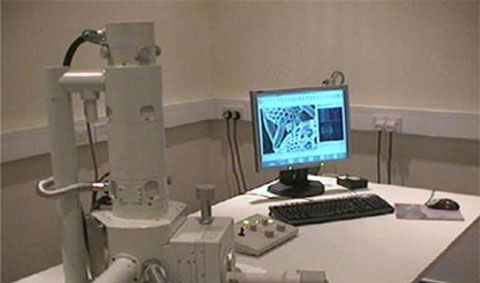
 The Institute disposes with variety of advanced techniques used for materials preparation, characterisation and processing.
- methods for characterisation of physico-chemical and mechanical properties of materials
- methods suitable for phase and structural analysis
- spectral methods
- methods for preparation and processing of functional ceramic and glass materials
- many others.